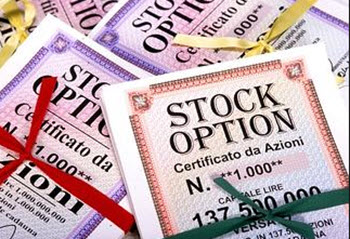
A call stock option gives its holder a right, but not an obligation, to buy the underlying stock for a certain price (the strike price*) during a certain period of time.
A put stock option gives its holder a right, but not an obligation, to sell the underlying stock for a certain price (the strike price*) during a certain period of time.
* Also known as the exercise price.
Stock options are derivatives because their value is connected to another financial asset. In this case, the underlying asset is a company share. The value of an option can change when the share price moves, but it is also affected by factors such as the strike price, the amount of time remaining before expiration and expected volatility in the underlying stock.
The holder of an option has a right rather than an obligation. This is one of the main differences between an option and many other financial contracts. A call option holder can decide not to buy the shares if exercising the option would make no economic sense. A put option holder can similarly allow the contract to expire without exercising it.
The person who creates and sells the option is commonly referred to as the option writer. The writer has obligations if the holder decides to exercise according to the terms of the contract. This means that the risk profile of the option buyer and the option writer can be very different.
Please note that stock options and binary options are two very different things even though both can be stock-based. Binary options work very differently from what I describe below. You can read more about binary options here (our guide) and here (in-depth binary options website).
How does a stock option work?
A stock option has several terms that determine what the holder can do. Important terms normally include the underlying share, the strike price and the expiration date. The market price of the option itself is usually called the premium. The buyer pays the premium to obtain the rights attached to the contract.
Suppose a stock is trading at USD 50 and you buy a call option with a strike price of USD 55. The option gives you the right to buy the underlying shares for USD 55 according to the contract terms. If the share price later rises substantially above USD 55, that right can become valuable because the contract allows you to buy at a price below the prevailing market price.
If the stock instead remains below USD 55 until the option expires, exercising the call would normally make little sense because you could buy the shares more cheaply in the ordinary market. The option can therefore expire without being exercised. The option buyer’s loss is then normally associated with the premium paid for the contract, assuming no other position or strategy is involved.
A put option works in the opposite direction. A put with a strike price of USD 50 gives its holder the right to sell the underlying shares for USD 50 according to the contract terms. If the market price falls well below USD 50, that right can become increasingly valuable.
Call options
Call options are commonly associated with bullish market expectations. A trader who believes a share is likely to rise can purchase a call rather than buying the shares directly. The amount paid for the option can be substantially smaller than the cost of purchasing the equivalent number of underlying shares.
This does not mean that buying calls is automatically less risky in every sense. Options expire. A shareholder can continue owning a stock after an expected price increase fails to occur on schedule. An option holder has a deadline. If the expected movement happens after expiration, it does not rescue the expired contract.
The strike price also matters. A stock can increase in value without the call becoming profitable enough to cover the premium paid. It is therefore not sufficient to predict direction alone. The trader also needs to consider how far the share might move and how quickly that movement could happen.
Put options
Put options are often associated with bearish expectations because they can gain value as the underlying share price falls. They can therefore be used for speculation on declining prices.
Puts can also be used for hedging. An investor who already owns shares might buy a put to reduce the financial effect of a severe decline. The put can gain value as the underlying shares fall, partially offsetting losses elsewhere in the portfolio.
Hedging has a cost because the option premium must be paid. This is similar to insurance in one important sense: protection can have value even when the unwanted event never happens. If the share price rises and the put expires unused, the investor may still have benefited from knowing that part of the downside was protected during the life of the option.
Strike price
The strike price is one of the central parts of every stock option. It determines the price at which the holder has the right to buy the underlying stock with a call or sell it with a put.
Different options on the same stock can have different strike prices. A company whose shares trade at USD 100 might have calls and puts with strike prices of USD 90, USD 95, USD 100, USD 105 and USD 110, among many others.
The relationship between the strike price and the current share price affects the option premium. An option that already has favourable exercise economics will normally be priced differently from one that requires a substantial future movement before exercising becomes attractive.
In the money, at the money and out of the money
Options are frequently described as being in the money, at the money or out of the money. These terms describe the relationship between the strike price and the price of the underlying share.
A call option is in the money when the underlying share price is above the strike price. A put option is in the money when the share price is below the strike price. An option with a strike close to the current share price is commonly described as at the money.
A call with a strike above the current share price is out of the money, while a put with a strike below the current share price is out of the money. An out-of-the-money option can still have value before expiration because the market price of the underlying share can change before the contract expires.
Being in the money does not automatically mean that an option trade has produced a net profit. The premium originally paid for the option also needs to be considered. An option can have intrinsic value at expiration but still produce an unsatisfactory result after the purchase price is taken into account.
The option premium
The premium is the price paid for an option. It changes continuously while the option is actively traded. The premium reflects what market participants are willing to pay for the rights contained in the contract.
Part of an option’s value can come from the immediate economic benefit of exercising it. Another part can come from the possibility that the underlying share will move favourably before expiration. An option with plenty of time remaining can therefore retain value even when exercising it immediately would not be worthwhile.
Volatility can also have a large effect on premiums. If traders expect a stock to make unusually large price movements, the chance of an option becoming valuable before expiration increases. This can cause option premiums to rise even if the current stock price has not moved very far.
Expiration dates
Stock options do not normally remain valid forever. They have an expiration date, after which the rights associated with the contract cease to exist. This makes time an important part of option trading.
An investor buying shares can often continue holding them while waiting for an investment thesis to develop. An option trader does not necessarily have this luxury. A correct prediction made too early can still result in a losing option trade if the contract expires before the expected market movement occurs.
Options with more time remaining generally have more opportunity for the underlying share to move. This time has economic value. As expiration approaches, the amount of remaining time becomes smaller and this can reduce the value of an option, all else being equal.
What’s the difference between a European-style stock option and an American-style stock option?
A European-style stock option can only be exercised on its expiration date. This means that you can only use it to purchase (call option) or sell (put option) the underlying stock on the expiration date.
An American-style stock option can be exercised on any day until it has expired. This means that you can only use it to purchase (call option) or sell (put option) the underlying stock on any day until the option has expired.
The terms European-style and American-style describe the exercise rules, not necessarily where the option was issued or traded. An American company can have options with European-style exercise terms, and the names should not be interpreted as geographical restrictions.
The additional flexibility of American-style exercise can be valuable, but early exercise is not automatically the best choice. An option can contain remaining time value that would be given up by exercising it. Traders therefore often compare the economic value of exercising with the value that might be obtained by selling the option itself.
A stock option that is not European-style nor American-style is called exotic. You need to look into the option’s term sheet to find out the exact terms for exercising an exotic stock option.
Exotic option contracts can contain conditions that differ substantially from standard listed options. Some may only become active after the underlying stock reaches a certain level, while others can calculate payouts using prices observed over a period rather than one single closing price. This makes the exact contract terms particularly important.
Exercising an option compared with selling it
Owning a transferable stock option does not necessarily mean that you must exercise it to realise its value. If there is an active market for the contract, the holder can often sell the option to another participant before expiration.
This can be important because the option’s market price can contain both intrinsic value and remaining time value. Exercising converts the option right into a transaction involving the underlying shares, while selling the option transfers the contract itself.
The most suitable action depends on the contract, market price, transaction costs and the investor’s objective. A trader who only wanted to speculate on the option premium may have no interest in acquiring or delivering the underlying shares at all.
Option writers
The option buyer pays for a right. The option writer accepts an obligation in exchange for receiving the premium. This distinction is fundamental to understanding the risks involved.
A call writer can be required to sell the underlying shares according to the contract if the holder exercises. A put writer can be required to buy the underlying shares at the strike price.
A covered call is one example where an investor writes call options while already owning the underlying shares. The shares can be delivered if assignment occurs. Writing an uncovered call can involve substantially greater risk because the writer does not already own the shares required to meet the obligation.
Writing puts can also create substantial obligations. If a stock falls far below the strike price, the writer can still be required to purchase shares at the higher strike price. Receiving an option premium does not remove this downside.
Why investors use stock options
Stock options are used for several different purposes. Some traders buy options to speculate on future share-price movements. Others use them to hedge an existing investment, while more advanced traders combine several option positions to create a defined risk and reward profile.
A trader expecting a stock to rise might buy a call. Someone expecting it to fall might buy a put. An investor who already owns shares can buy protective puts or write calls depending on the objective and willingness to accept the resulting obligations.
Options can also be used to express views about volatility rather than simple market direction. Because expected volatility affects option premiums, some strategies are designed around whether future price movement is likely to be greater or smaller than what the current option prices imply.
This flexibility is one reason options are useful and one reason they can become complicated. Two traders can use the same underlying stock and reach completely different positions because one is trying to speculate, another is hedging and a third is trading volatility.
Stock options for hedging
Options can reduce the risk of another position. A shareholder concerned about a temporary decline can purchase a put giving the right to sell shares at a predetermined price. If the stock falls sharply, the put can increase in value and reduce part of the portfolio loss.
The cost of this protection is the option premium. If the stock never falls, the put can expire without being exercised. This does not necessarily mean the hedge served no purpose. The investor paid for protection against an event that did not occur.
Hedging can also reduce potential returns. The premium paid lowers the net performance of the investment, and some option strategies place a ceiling on gains in return for receiving premium or reducing downside risk.
Stock options for speculation
Options are attractive to speculators because a relatively small premium can provide exposure to the movement of a much larger underlying stock position. This creates leverage.
Leverage can result in a large percentage gain when the forecast is correct. It can also cause the entire premium to disappear when an option expires without sufficient value. The fact that the cash investment is smaller than the value of the underlying shares should therefore not be confused with low risk.
Options also require more precise forecasting than simply buying a stock. A trader can be correct that a company will perform well but still lose money if the rise occurs too slowly, if the option was too expensive or if implied volatility falls enough to reduce the premium.
Why volatility matters
Volatility describes how much the underlying share price moves. Expected future volatility is an important input in option pricing because larger potential movements increase the chance that an option could finish with substantial value.
This means an option can become more expensive before a major company announcement even when the share price itself barely changes. Traders might expect an earnings report, court ruling or regulatory decision to cause a large price movement, increasing demand for options before the event.
After the event, expected volatility can fall sharply because the uncertainty has disappeared. An option buyer can therefore predict the direction of the share correctly yet see a smaller profit than expected if the decline in volatility offsets part of the favourable price movement.
Time decay
Options lose remaining time as they approach expiration. All else being equal, an option with six months left has more opportunity for a favourable movement than an otherwise identical option with only two days remaining.
This gradual reduction in time value is commonly referred to as time decay. It is particularly important for option buyers because time can work against a position even when the underlying stock is not moving in the wrong direction.
A trader might buy a call expecting a stock to rise from USD 50 to USD 60. If the stock remains near USD 50 for most of the option’s life, the contract can lose value as expiration approaches. A late rally might therefore need to be larger than originally expected to compensate for the time value already lost.
Where can I buy a stock option?
Stock options are traded-over-the counter (OTC) and on exchanges.
Employee stock options that can only be exercised by the original holder are, of course, not traded.
An exchange will typically only allow the trade of highly standardized contracts, and trade is typically carried out through a clearinghouse which means that the seller and the buyer doesn’t necessarily know each others identity. The exchange will set rules for the stock option and its trade and enforce those rules. Most exchanges will automatically step in and honor a listed stock option in case the writer (creator of the stock option) is unwilling or unable to do so.
Exchange-traded options are normally standardized around factors such as the underlying asset, contract size, strike prices and expiration dates. Standardization helps create a market where many buyers and sellers can trade comparable contracts rather than negotiating every term separately.
The clearing process also reduces direct counterparty exposure between individual buyers and sellers. Traders do not normally need to investigate the personal financial strength of whoever originally took the opposite side of the listed contract before placing every trade.
Trading stock options outside an exchange means that you don’t get type of protection offered by an exchange. On the other hand, certain stock options are not listed with any exchange so over-the-counter (OTC) trading is you only option. OTC-traded stock options aren’t necessarily standardized, so inspecting the term sheet becomes even more important. It is also up to you to determine if you think the writer (creator of the stock option) will honor it, because no one will step in and honor the stock option if the writer shirks.
OTC options can be useful because the buyer and seller can agree on terms that are not available through standardized exchange contracts. A business might need an option covering an unusual number of shares, a particular expiry date or another feature that is not available in the listed market.
This flexibility comes with additional complexity. Every important part of the agreement needs to be understood because there might not be a standardized rule filling in the gaps. Counterparty risk also becomes more important when the contract depends directly on the other party performing as promised.
Examples of important details to check out in the term sheet:
Is this option European-style, American-style or Exotic?
Is the writer allowed to refrain from actually selling/buying the underlying stock by giving your money instead?
A company can issue various types of stock, e.g. A stock and B stock. Which type is this stock option for?
The term sheet can also specify the exact expiration time, contract size, settlement method and what happens if the underlying company experiences a corporate event. Stock splits, mergers, special dividends and takeovers can affect the underlying shares and may require adjustments to an option contract.
Physical settlement and cash settlement
Some options are physically settled, meaning that exercising the contract results in the underlying shares being bought or sold according to the option terms. Other contracts can be cash settled, where money changes hands instead of the shares themselves.
Settlement terms matter because they determine what actually happens after exercise or expiration. A trader interested only in price speculation might prefer not to receive a large share position unexpectedly, while an investor using an option as part of a share strategy might specifically want physical delivery.
Never assume how an option will settle simply because another contract with a similar name works in a certain way. The contract specifications determine the obligation.
Employee stock options
Employee stock options differ from ordinary exchange-traded options. They are generally issued by a company to employees or executives as part of compensation and cannot normally be sold freely to another investor.
Employee options can include vesting periods that require the employee to remain with the company for a certain time before exercising. They can also contain rules governing what happens if employment ends.
Because these options are compensation rather than ordinary exchange-traded contracts, their tax treatment and restrictions can also differ. Someone receiving employee stock options should therefore read the plan documentation rather than assuming ordinary listed option rules apply.
Risks of buying stock options
An option buyer can lose the entire premium. This can happen even when the underlying stock moves in the expected direction if the movement is too small, arrives too late or other changes in option pricing work against the position.
Liquidity can also be a problem. Some options trade actively with narrow bid and ask spreads, while others have very few buyers and sellers. A wide spread increases transaction costs and can make it harder to close a position at a favourable price.
Complexity itself is another risk. Option values respond simultaneously to the underlying price, time, volatility and other factors. A trader can understand the company perfectly and still misunderstand how the particular option contract will respond.
Risks of writing stock options
Writing options can expose the seller to substantially different risks from buying them. The writer receives the premium but accepts an obligation if the holder exercises.
An uncovered call can be especially dangerous because a stock price can theoretically continue rising while the writer remains obligated to deliver according to the contract terms. The potential loss can therefore become very large.
Writing puts can also result in large losses if the underlying company collapses in value. The writer might be required to buy shares at a strike price far above their new market value.
The premium received at the beginning can look attractive because it is collected immediately. It should always be compared with the obligation being accepted in return.
Why stock options can be useful
Stock options allow investors to build positions that would be difficult to reproduce by buying and selling shares alone. They can limit the upfront amount committed to a speculative trade, provide downside protection for an existing portfolio or generate premium in exchange for accepting defined obligations.
The same flexibility makes them less straightforward than ordinary share ownership. Strike price, expiration, exercise style, premium, volatility and settlement all affect the final result.
The most important step before trading an option is therefore to understand exactly what right or obligation the contract creates. Knowing whether the market is likely to rise or fall is only the beginning. The trader also needs to know when the option expires, how it can be exercised, how much was paid or received for it and what will happen if exercise or assignment occurs.
Used carefully, stock options can be powerful instruments for speculation and risk management. Used without understanding the contract, they can turn a relatively simple opinion about a stock into a much more complicated financial problem.
This article was last updated on: September 14, 2026